How Much Can a Landlord Raise Rent? Notice Periods and Caps in Every State
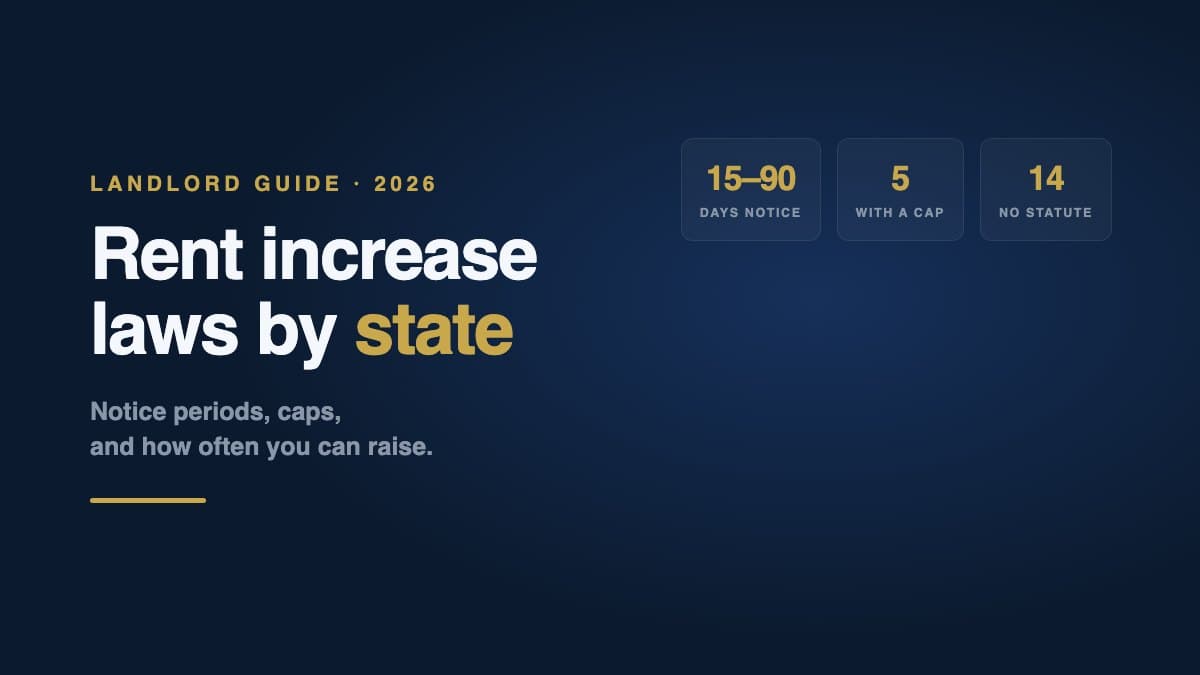
Rent increases usually fail on notice, not amount. The written notice every state requires, the five places with a cap, and who limits how often.
Most landlords worry about the wrong half of a rent increase. They agonise over the number and then serve it in a way that makes it unenforceable.
In 36 states there is no cap at all on how much you can raise rent. What there is, almost everywhere, is a rule about how much written warning you give — and that is where increases actually fall apart. Get the notice wrong and the tenant can keep paying the old rent while you wait out a new notice period.
Here is what every state requires, the five places that limit the amount, and the handful that limit how often you can raise at all.
Four Rules That Apply Almost Everywhere
1. A fixed-term lease locks the rent
This is the one that catches new landlords. For the duration of a fixed term, the rent is the rent. You can raise it when the term ends — for a renewal or a conversion to month-to-month — but not in month seven of a twelve-month lease.
Two exceptions. The lease may contain an escalation clause the tenant agreed to at signing ("rent increases to $1,950 in month 13"), which is enforceable precisely because they agreed to it. Or the tenant may sign a written amendment mid-term, which is a negotiation, not a notice — they are free to decline.
Without one of those, a mid-term increase is unenforceable. The tenant can keep paying the original amount, and treating the difference as nonpayment is how a rent increase turns into a lawsuit.
2. The notice must be in writing
Verbal notice is worthless in a dispute even where a statute does not explicitly require writing. You want a dated document stating the current rent, the new rent, and the date it takes effect — and a record of how and when you delivered it.
3. The clock runs to the effective date, not the notice date
A 60-day notice served on 1 March does not take effect on 1 April. It takes effect on the first rent period beginning at least 60 days after service — in practice, 1 May. Counting from the wrong end is the single most common error, and it is the one that most often invalidates an otherwise reasonable increase.
4. The amount can be unlimited but not retaliatory
Where there is no cap, you can raise rent as much as the market will bear. You still cannot raise it because the tenant reported a code violation, joined a tenants' association, or belongs to a protected class. A number of states, Colorado among them, also protect source of income and military status.
Rent Increase Notice by State
Minimum written notice for a month-to-month tenancy unless stated. Where the table says "no statute", the lease governs — and if the lease is silent, 30 days is the customary practice.
| State | Notice required | Cap on amount |
|---|---|---|
| Alabama | No statute | None |
| Alaska | 30 days | None |
| Arizona | 30 days | None |
| Arkansas | 1 month | None |
| California | 30 days under 10%; 90 days 10%+ | 5% + CPI, max 10% |
| Colorado | 60 days (no written lease; lease terms govern if written) | None |
| Connecticut | 45 days | None |
| Delaware | 60 days | None |
| Washington DC | 60 days minimum | Capped on rent-controlled units |
| Florida | No statute | None |
| Georgia | 60 days | None |
| Hawaii | 45 days | None |
| Idaho | 30 days | None |
| Illinois | No statute | None |
| Indiana | 30 days | None |
| Iowa | 30 days | None |
| Kansas | 30 days | None |
| Kentucky | No statute | None |
| Louisiana | No statute | None |
| Maine | 45 days; 75 days if increases total 10%+ over 12 months | None |
| Maryland | 60–90 days by tenancy length | None |
| Massachusetts | 30 days | None |
| Michigan | No statute | None |
| Minnesota | 30 days | None |
| Mississippi | 30 days | None |
| Missouri | No statute | None |
| Montana | 30 days | None |
| Nebraska | 30 days | None |
| Nevada | 60 days | None |
| New Hampshire | 30 days | None |
| New Jersey | 30 days | Local rent control in many towns |
| New Mexico | 30 days | None |
| New York | 30 days under 1 yr; 60 days 1–2 yrs; 90 days 2+ yrs | Capped on stabilised units |
| North Carolina | No statute | None |
| North Dakota | 30 days | None |
| Ohio | No statute | None |
| Oklahoma | No statute | None |
| Oregon | 90 days | 7% + CPI, max 10%; none in year 1 |
| Pennsylvania | No statute | None |
| Rhode Island | 60 days; 120 days if tenant is 62+ | None |
| South Carolina | No statute | None |
| South Dakota | 30 days | None |
| Tennessee | No statute | None |
| Texas | No statute | None |
| Utah | 15 days | None |
| Vermont | 60 days | None |
| Virginia | 30 days; 60 days with renewal provisions | None |
| Washington | 90 days | Lesser of 7% + CPI or 10% |
| West Virginia | No statute | None |
| Wisconsin | No statute | None |
| Wyoming | No statute | None |
The Five Places With a Cap
Everywhere else, the amount is between you and the market. In these five, it is not.
California — the Tenant Protection Act caps annual increases at 5% plus regional CPI, or 10%, whichever is lower, and permits no more than two increments in any 12-month period. The figure is recalculated each year from April CPI and differs by region: for increases effective August 2026 through July 2027 it is 8.7% in the Los Angeles area and 8.8% around San Francisco. Buildings under 15 years old and most single-family homes not owned by a corporation are exempt.
Oregon — no increase at all during the tenant's first year, then an annual cap of 7% plus CPI, maximum 10%. Ninety days' written notice for any increase.
Washington — the newest and the one most likely to catch people out. HB 1217 took effect in May 2025 and caps most increases at the lesser of 7% plus CPI or 10%; the figure for increases taking effect in 2026 is 9.683%. Ninety days' notice, no increase during the tenant's first 12 months, and a tighter 5% cap for manufactured housing. Guides published before mid-2025 still say 60 days with no cap — they are out of date.
New York and Washington DC cap increases on rent-stabilised and rent-controlled units, set annually by a board rather than a statewide formula. Market-rate units in both follow the ordinary notice rules.
The States That Limit How Often
Separate from the notice period, and easy to miss:
- Colorado — one increase per 12 months of the tenant's continuous occupancy. The clock follows the tenant, not the lease, so it carries straight across a renewal.
- California — at most two increments in any 12-month period, inside the overall cap.
- Oregon and Washington — no increase during the first 12 months of tenancy.
Colorado's is the one that bites quietly. A landlord who raises rent at renewal in March and again when the tenant goes month-to-month in November has broken it, even though both increases were individually well-noticed.
Getting the Notice Right
The document itself is not complicated. It needs the tenant and property, the current rent, the new rent, the date it takes effect, and the date you served it. What matters is the arithmetic around it:
- Check the lease first. Statutory minimums are floors. A lease requiring 90 days beats a state requiring 60, and your own lease is the agreement a judge reads first.
- Count forward to the next full rent period. Not to a date 60 days out — to the first period that begins after the notice period has run.
- Check the frequency rule, not just the notice period, and check it against the tenant's whole occupancy rather than the current lease.
- Keep proof of delivery. The notice you cannot prove you served is the notice you did not serve.
- Do not raise rent mid-term unless the lease already said you could.
If you are managing this across more than a couple of units, the dates are the hard part — the notice period, the effective date, and the twelve-month clock all run on different calendars. Pacific Rentals Pro tracks lease terms, renewal dates and rent history per unit, so the next increase is a decision rather than an archaeology project.
While you are in the paperwork: our security deposit return deadlines guide covers the other clock that catches landlords out, and the late fee rules by state cover what you can charge when rent arrives late.
This is general information, not legal advice. Statutes change, cities layer their own rules on top, and several of the figures above are recalculated annually from CPI. Check your current state statute, and talk to a local landlord-tenant attorney before serving a notice you intend to rely on.